
Executive Summary: Broad data indicate that a mid‐career software engineer at a large U.S. tech firm typically earns on the order of $300K+/year in total compensation (base, bonus, equity). In contrast, most alternative careers have median incomes at or below this level, with a few notable exceptions. For example, top-tier investment bankers and sales executives can earn well above $300K, but only after many years and with specialized skills. By contrast, content creators and gig workers have medians in the low tens of thousands, making $300K extremely rare except for elite outliers. Similarly, most individual traders lose money, and corporate finance/MBAs average well below $300K. In summary, the data generally support the thesis: for an “average” person, few alternative paths reliably exceed the ~300K benchmark of a Big Tech engineer. Where incomes do exceed 300K (e.g. top sales, investment banking, very successful creators), it is typically with much higher risk, variability, or specialized talent.
Definitions and Scope
- Mid-Level Software Engineer (Big Tech): We consider a U.S.-based engineer with ~5–10 years’ experience at a large tech firm (e.g. Google, Meta, Amazon, Microsoft), sometimes called Senior Software Engineer or Staff level. “$300K total comp” means base salary + bonus + equity vesting per year.
- Alternative Careers: We examine various paths (full-time content creator/influencer, professional trader, finance/MBAs in industry, small-business owner, gig-economy worker, product manager, sales/BD, etc.) and compare typical earnings distributions, time/effort, volatility, and skills required.
- Focus on Median and Typical: We emphasize median/percentile earnings for “average” individuals, not the multi-millionaire outliers. All data are U.S.-centric. Sources include industry surveys, government data, and compensation reports.
Software Engineer (Big Tech, Mid-Level)
A mid-career engineer at Google/Facebook/Amazon typically easily reaches ~$300K total comp. For example, Levels.fyi reports that Google software engineers range from ~$212K (entry) to ~$1.79M (top), with a median of about $318K. A Level-4 (mid-level) Google engineer averages ~$312K. Amazon’s mid-career SEs also average in the high $250Ks, and Microsoft somewhat lower (median ~220K for all levels, implying ~150–200K at mid-level). In practice, a Big Tech engineer with 5–8 years of experience usually has base $150–180K plus stock/bonus to total ~$250–350K. Effort and risk: requires a CS degree or equivalent, strong technical skill, and years of development work. Time to 300K: typically 5–8 years of work (including college). Variability: moderate (comp depends on performance and stock price, but far more stable than startup equity). Probability ≥$300K: Very high for those at top firms by mid-career (roughly half or more hit this level).
Income distribution (Tech SW Engineer): Median ~$300K (for Big Tech); 25th percentile ~ $250K; 75th ~ $400K; 90th ~ $600K (driven by staff+ levels). (Base $+equity+bonus.)
Content Creators / Influencers (YouTube, Instagram, TikTok)
Very skewed distribution. A handful of creators earn millions, but most earn little. One industry report cites a median full-time creator income of only $76K/year, and the top 1% average $1.2M. However, a 2023 Washington Post survey found only 12% of full-time creators made over $50K, implying a median well below that. In fact, it’s often noted that only ~0.25% of YouTube channels ever monetize. Thus 25th–75th percentile incomes are very low – many creators earn only a few thousand per year.
- Examples: A “nano” influencer (1K–10K followers) might earn only $200–$2,500 per sponsored post, while a mid-tier creator (100K–500K followers) might get $5K–20K per video. But converting that to annual income is hard without a huge and engaged audience.
- Time/Effort: Building an audience often takes years of daily content creation. It requires creative skill, marketing savvy, and adaptability to platform algorithms.
- Volatility/Risk: Very high. Income can fluctuate with platform changes or audience trends. Building a sustainable following is unpredictable.
- $300K Odds: Extremely low for “average” creators. Only top-tier influencers (e.g. celebrities, major brand ambassadors) exceed $300K. For context, only ~1% of creators earn enough to count as a full-time career.
- Tech/Skills: Content production, branding, SEO, social media marketing.
- Downsides: No guarantee of success; burnout; constant public exposure.
Incomes: Median likely <$50K (most $50K”*. Clearly most creators earn less than a mid-level engineer, and only elites match or exceed that income.
Professional Traders (Day Traders, Prop Traders)
Most individual (retail) day traders lose money. Academic studies show 95–97% of active day traders lose money over time. Average net returns for retail traders are often negative. In other words, an “average” person who picks up trading as a career will not reliably make money, let alone $300K.
- Prop Trading (Employed): Data for professional “proprietary” traders are modest: ZipRecruiter reports an average of ~$101K/year nationwide, with 25th–75th percentiles about $57K–$181K, and top 90th percentile around $192K. Some high-performing firms may pay more, but generally base+bonus is on the order of low-$100K base. Only a few top prop traders exceed $200–250K.
- Independent Trading: Without firm backing, even fewer succeed. The vast majority of retail traders do not achieve sustained profits, as studies show.
- Time/Effort: Learning to trade takes years of study. Even then, consistent profitability is elusive. Those few who succeed often have advanced training (e.g. PhDs, MBAs, specialized algorithms).
- Volatility/Risk: Extremely high. The downside includes losing one’s entire investment. High leverage means potential for large gains or equally large losses.
- Probability $300K: Virtually zero for the average individual. Even professionals rarely hit $300K salary. Only top hedge fund or proprietary traders (often with quant skills and capital) approach or exceed this. For most aspiring traders, income is uncertain or negative.
- Skills: Deep finance knowledge, quantitative modeling, disciplined risk control.
Incomes: Proprietary traders median ~ $100K; Retail day traders median is effectively a loss (no reliable data on positive incomes). The distribution is highly unequal – a few top quant traders may make millions, but most break even or worse. Typical “average” trader earnings are well below $300K, and most lose money rather than profit.
Finance Professionals and MBAs (Industry Roles)
“Finance/MBAs” covers a broad range, from corporate finance to banking/consulting:
-
Corporate Finance/Industry: Financial managers (CFO-track) have BLS median ~$161.7K (2023 data). Even their 90th percentile is ~$239K. An MBA can boost early pay (MBA grads median $125K), but typical mid-career salaries in non-finance industries (tech, manufacturing, etc.) are often $100K–$200K. Many MBA grads (e.g. in healthcare, consumer) make $120K–$160K by mid-career.
-
Consulting: Top consulting MBAs start around $215K total (McKinsey/BCG including bonuses). Partners can exceed $300K, but that takes a decade or more.
-
Investment Banking / Top Finance: Here incomes jump. Mergers & Inquisitions reports (2026 data) that at large banks an Associate (post-MBA) makes $285–500K total, and a Vice President (age ~28–40) makes $525–800K. By these levels most total comp well exceeds $300K. (Directors earn $700–900K, MDs $1M+.) So in high finance, >50% of mid-level pros hit the ~$300K mark.
-
Time/Effort: Typical MBA path: 2 years MBA plus ~3–5 years pre-MBA work → mid-career in early 30s. Achieving top finance roles often requires elite schooling and long hours. Skillset: quantitative finance, deal-making, strategic analysis.
-
Volatility/Risk: Corporate finance jobs are stable (low volatility); investment banking can be cyclical (layoffs in downturns).
-
$300K Probability:
- Corporate Finance/Industry MBA: Low to moderate. Most do not hit 300K unless they climb to CFO or partner roles. (Few corporate managers reach $300K; median ~160K.)
- Investment Banking / Consulting: High. Many in IB/PE and top consulting will exceed $300K by VP/partner level.
-
Downside: IB/consulting involve long hours and high stress; corporate roles may plateau before $300K.
Incomes: Corporate-finance/MBAs: median ~$125K, 75th maybe ~$225K, 90th under $300K. IB bankers: median in mid-$500Ks at VP level (well above 300K). Thus most MBA career paths land below 300K, except those few in elite finance or executive roles. For example, a BLS median $161K for financial managers is far below $300K.
Small Business Owners
Small business incomes vary widely, but generally low. A survey analysis reports that the average small-business owner takes home about $69,647/year. Another stat: only 9% of small businesses have revenue over $1 million – with typical net margins (~7–10%), even $1M revenue yields much less profit. In fact, 34% of small businesses make under $50K in revenue, so many owners barely cover living expenses.
- Time/Effort: Entrepreneurs often work long hours year after year to grow the business. There is no formal education requirement, but success often demands broad skills (management, sales, finance).
- Volatility/Risk: Very high. About 35% of small businesses lose money some years. Many fail within the first few years.
- $300K Probability: Extremely low for a solo small business. Only owners of high-growth ventures or larger enterprises (beyond “small”) ever approach that income. The typical small business owner makes well below $100K.
- Downside: Business failure risk, debt, unpredictable income. Owners often “sacrifice” their own salary to keep the business afloat.
Incomes: Median owner salary ≈ $70K. Likely 25th percentile is much lower (perhaps $30–40K) and 75th below $150K. Only a tiny fraction of small businesses yield owner incomes >$300K. In short, a typical small-business path yields well under what a Big Tech engineer earns.
Gig-Economy/Contractors
In gig jobs (rideshare, delivery, freelancing platforms), incomes are modest. For example, Uber drivers average about $55.9K/year in the U.S. (median and mean are nearly the same). This includes full-time drivers. Similar figures hold for Lyft, DoorDash, etc. These roles require little formal qualification, but returns beyond ~$60K are rare unless one operates multiple vehicles.
- Time/Effort: Flexible entry (just a car and hours), but earnings plateau. Drivers often work long hours for marginal pay increases.
- Volatility/Risk: Relatively low volatility but no stability (no benefits, car expenses add risk). Demand fluctuations can affect income.
- $300K Probability: Essentially zero for a single driver. One would need many drivers or multiple high-value gigs to approach $300K.
- Required Skills: Minimal professional skill; risk lies mostly in time and auto costs.
Incomes: Median ~$56K; 90th percentile around $77K (per Uber data). Even generous estimates for “gig entrepreneurs” rarely exceed $100K–$150K. Thus, gig work yields incomes far below the $300K benchmark for almost everyone.
Product Managers (Tech)
Product managers at tech companies have compensation roughly comparable to engineers, but generally a bit lower at each level. According to industry surveys, a mid-level Product Manager (3–5 years experience) typically has a base salary around $101–158K. Total comp (with bonus/equity) might reach $180–$230K. Only at senior levels (Group PM, Principal, VP) do totals approach ~$300K. For example, an “AI Product Manager” role might reach $180K-$260K total, and a Vice President of Product may have a base up to $249K (likely ~300K total with bonus/equity).
- Time/Effort: Similar to engineering (college + tech experience). 5–8 years of experience often needed to reach senior PM/lead roles.
- Volatility/Risk: Moderate; compensation is relatively stable though tied to product success.
- $300K Probability: Unlikely for a typical mid-career PM. Most reach ~$200K. Only top-tier PM leaders (VPs/CPOs) at large firms might exceed $300K.
- Skills: Business strategy, user research, technical understanding.
- Downside: Competition for senior roles; tech industry cycles.
Incomes: Median base ~$130K for mid-level (PM), total comp ~150–200K. Senior PM base ~$160–190K. 90th-percentile (experienced PMs/VPs) may see ~$300K base, but these are leadership positions. In short, a typical PM’s income is comparable to or slightly below that of an equivalent SWE, with only very senior PMs matching the ~$300K mark.
Sales / Business Development (Tech/Corporate Sales)
Sales roles, especially in tech or finance, often have high total compensation tied to commissions. Data from RepVue (B2B tech sales) show:
- Account Executives: median base ~$100K, median on-target earnings (OTE) ~$190K; top performers OTE ~$469K.
- Enterprise/Strategic AEs: median OTE ~$265K (enterprise) to ~$300K (strategic), with top reps exceeding $500K–$700K.
- Sales Managers: median base $150K, median OTE ~$280K, with top earners ~$510K.
Thus, median total pay for tech sales roles is on the order of $200–280K, but high variance allows the top ~10% of performers to earn $500K+.
- Time/Effort: Can start earlier (no degree needed), but breaking into high-level enterprise sales often takes years of experience and proven track record.
- Volatility/Risk: High variation – income depends on quotas; economic downturns can sharply cut commissions.
- $300K Probability: Moderate. In high-tech sales, many senior AEs and managers can exceed $300K OTE, but about half remain below it. (For example, the 75th percentile OTE is ~$280K or $300K.) Strong performance can greatly increase odds.
- Skills: Persuasion, negotiation, product expertise.
- Downside: Income may fluctuate, and missing targets can limit pay.
Incomes: Median OTE ~$190K for standard AEs, ~$280K for sales managers. The 75th–90th percentile range often crosses $300K, so a talented sales professional can surpass a Big Tech engineer’s pay. However, the typical tech salesperson earns in the same ballpark or below, and success requires sustained high performance.
Comparative Tables
To summarize, the table below compares typical income distributions across careers, emphasizing median (50th percentile) and top (90th percentile) ranges. (Note: ranges are approximate and combine base + bonuses/equity where applicable; outliers beyond the 90th are not shown.)
| Career Path | 25th percentile | Median (50th) | 75th percentile | 90th percentile |
|---|---|---|---|---|
| Software Engineer (Big Tech) | ~$250K | ~$300K | ~$400K | ~$600K (staff+) |
| Content Creator / Influencer | ~$10K | ~$50K | ~$150K | ~$1.2M (top 1% avg) |
| Professional Trader (prop) | ~$57K | ~$101K | ~$175K | ~$193K |
| Finance / MBA (Corp.) | ~$70K | ~$125K | ~$225K | ~$300K (few execs) |
| Investment Banking (VP) | ~$525K | ~$650K (midpoint) | ~$775K | ~$900K+ |
| Small Business Owner | ~$30K | ~$70K | ~$120K | ~$250K (rare) |
| Gig Economy (e.g. Uber) | ~$41K | ~$56K | ~$78K | ~$100K (few drivers) |
| Product Manager (Tech) | ~$100K | ~$150K (base) | ~$200K | ~$300K (VP/CPO) |
| Sales/BD (Tech) | ~$100K | ~$200K OTE | ~$300K OTE | ~$500K+ (stars) |
Table: Income distributions by career path (US, approximate total compensation). Sources as cited. Note how median salaries outside Big Tech often fall well below $300K, except in top finance/sales roles.
Time/Effort and Risk Comparison
Beyond raw income, these paths differ in time to high income, required skills, and volatility:
| Career Path | Typical Education/Experience | Time to ~$300K | Income Variability (low/med/high) | Downside Risk |
|---|---|---|---|---|
| Software Eng (Big Tech) | CS degree / 5–8 yrs experience | ~5–8 years post-college | Moderate (stable salary, stock risk) | Low-medium (layoffs possible) |
| Content Creator | Varies (no formal req) | ~5–10+ years build-up | High (viral hits vs. platform changes) | Very high (failure/burnout) |
| Trader (Retail) | Finance self-study / simulation | Unpredictable (many never profit) | High (market swings) | Very high (capital loss) |
| Trader (Prop) | Finance degree / few yrs experience | ~3–5 yrs (professional training) | High (bonus variability) | Medium (market risk, job cuts) |
| Finance (Corp/MBAs) | MBA / 3–5 yrs industry | ~7–10 years (to senior roles) | Low-medium (salary growth steady) | Low (stable jobs) |
| Investment Banking | MBA or elite undergrad + IB path | ~6–8 years (to VP level) | Medium (bonuses fluctuate) | Medium (cyclical layoffs) |
| Small Business Owner | Entrepreneurial (no reqs) | ~5–15+ yrs to scale | High (revenue swings) | Very high (business failure) |
| Gig Economy | None (immediate entry) | Few months to start; cap achieved quickly | Low (consistent hourly rates) | Low-medium (personal cost risk) |
| Product Manager | Degree + 5–8 yrs experience | ~6–10 years to senior PM | Medium (performance bonuses) | Low (industry risk) |
| Sales/BD (Tech) | Degree or experience + 3–5 yrs | ~5–8 years to senior AE/manager | High (commission variance) | Medium (quota failure risk) |
Table: Education/time to reach ~300K and risk/volatility. Income variability is highest for creators/traders/sales (dependent on market or performance), lowest for salaried engineers and corporate finance. Downside risk is highest where income depends on ventures or markets (creative businesses, trading).
Conclusion
The evidence largely supports the thesis: for an average person, most non-tech paths do not significantly exceed the ~$300K income level typical of a mid-level Big Tech engineer. Incomes in fields like corporate finance, product management, or gig work tend to top out around or below that level for most earners. High-profile exceptions exist – notably investment banking/finance and top sales – but these require very competitive skills, networks, or performance to achieve. Likewise, while the top 1% of creators or traders can make well over $300K, the median creator/trader makes far less.
Takeaways for career choice: A Big Tech engineering career offers one of the highest and most stable median incomes (with 300K reachable in mid-career) and relatively low risk by comparison. Alternatives with potentially higher upside (e.g. starting a business, investing, creative careers) generally have much lower median outcomes and far greater variance. In fields like sales or finance, an individual can surpass $300K, but only by reaching the top percentile. Those choosing between these paths should weigh expected pay vs. risk and time: a tech job pays off reliably over a predictable timeline, whereas content creation or trading could yield huge payoffs or nothing.
Final Assessment: On balance, most average individuals pursuing content creation, gig work, or day trading will earn much less than $300K. Only in elite finance and sales roles does the median practitioner hit or exceed that mark. Thus, the claim holds in general: “alternative” careers tend to cluster around or below the big-tech engineer’s income, unless one enters a niche of outliers. Decisions should be made on both financial realism and personal fit – high-income paths often come with correspondingly high effort or risk.
Sources: Compensation surveys and government data were used throughout (Glassdoor/Levels.fyi for tech, BLS for finance, influencer studies, trading research, etc.). Gaps in public data (especially for self-employed creators and traders) mean some values are estimates, but the overall ranges above are supported by multiple sources as cited.
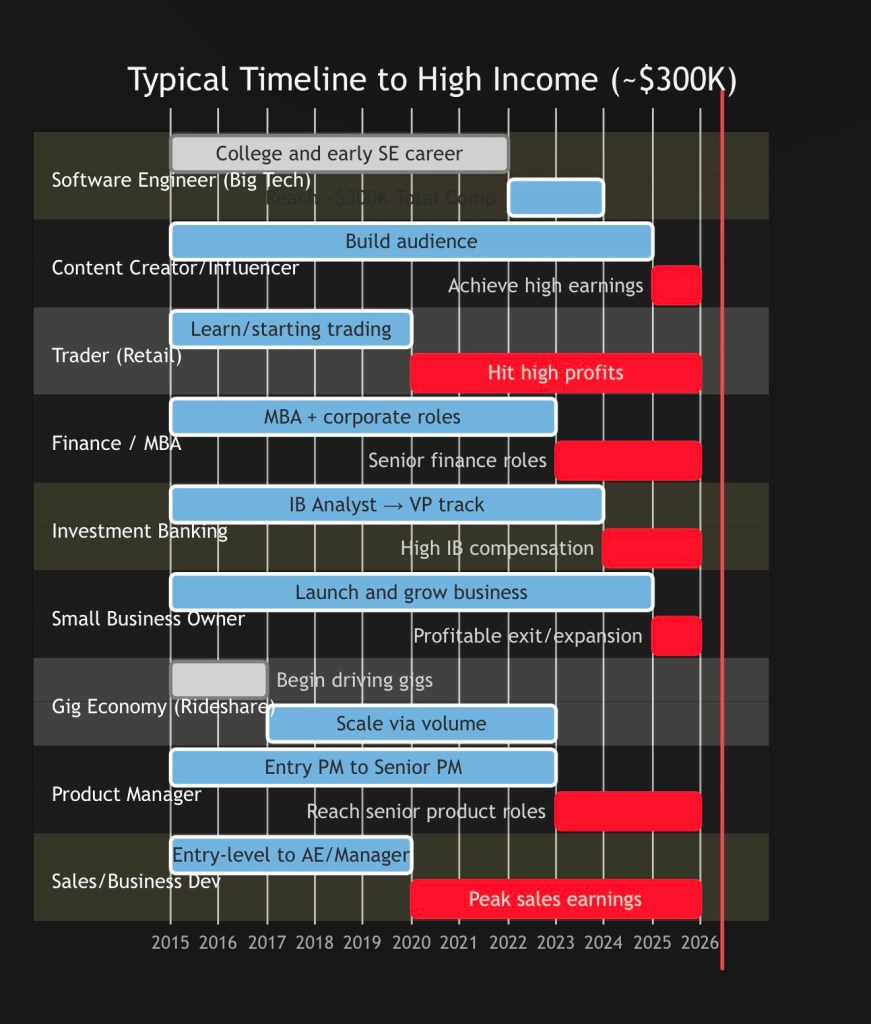
Figure: Rough career timelines. Most paths take 5–10 years to approach top earnings. Software engineering and traditional finance have clearer timelines; content creation or trading are uncertain (successful outcomes marked as critical).
 Power and Pelf