> “With great power comes great responsibility.” — And America gave Iran the power first.
Introduction
In July 2015, the world exhaled. After years of tense negotiations, Iran and six world powers — the United States, United Kingdom, France, Germany, Russia, and China — signed a landmark agreement called the JCPOA (Joint Comprehensive Plan of Action). Iran agreed to dismantle large parts of its nuclear program. In return, it would receive billions of dollars in sanctions relief.
It was hailed as one of the greatest diplomatic achievements of the 21st century.
Three years later, President Donald Trump tore it up.
Iran responded by announcing it would no longer comply with any of the enrichment limits. France, Germany, and the UK — America’s closest allies — began trembling. They started negotiating with Iran, begging it to stay within the limits. Iran’s response was essentially: go tell Washington to lift the sanctions first.
A country under crushing economic sanctions, isolated from the global financial system, with a GDP smaller than the state of Texas — was making the entire Western world nervous.
How did it come to this? The answer begins not in Tehran, but in Washington — in 1953.
It All Started With America: The Atoms for Peace Program (1953–1967)
On December 8, 1953, US President Dwight D. Eisenhower stood before the United Nations General Assembly and delivered a speech that would change the world. He called it “Atoms for Peace.”
The idea was elegant: nuclear technology is too powerful to be used only for weapons. Let America share the peaceful applications of nuclear science — power plants, medical research, industrial applications — with the world. In return, countries would agree to use nuclear technology only for civilian purposes and not pursue weapons.
It sounded noble. It was also strategically brilliant. America was the world’s dominant nuclear power. By sharing civilian nuclear technology, it could build relationships with developing countries, counter Soviet influence, and — crucially — monitor who was doing what with nuclear materials.
The beneficiaries included Israel, India, Pakistan, and Iran.
In 1967, the United States built Iran’s first nuclear reactor — a 5-megawatt research reactor — on the campus of Tehran University. America also supplied Iran with nuclear fuel: enriched uranium.
Let that sink in. The country that would spend the next 50 years trying to prevent Iran from having nuclear technology was the same country that gave Iran its first nuclear reactor and its first nuclear fuel.
As one analyst put it: “If you look at most of the blunders in the world, it all started either with the British or the United States.”
| Year | Event |
|---|---|
| 1953 | Eisenhower’s “Atoms for Peace” speech at UN |
| 1957 | US-Iran nuclear cooperation agreement signed |
| 1967 | US builds Iran’s first nuclear reactor at Tehran University |
| 1968 | Iran signs Nuclear Non-Proliferation Treaty (NPT) |
| 1974 | Iran establishes Atomic Energy Organization of Iran |
| 1979 | Iranian Revolution — Shah overthrown, Western support ends |
| 1984 | US adds Iran to state-sponsored terrorism list |
| 1987 | A.Q. Khan sells centrifuge designs to Iran |
| 2002 | Iran’s secret nuclear facilities exposed |
| 2015 | JCPOA signed |
| 2018 | Trump withdraws from JCPOA |
| 2020 | US assassinates General Qasem Soleimani |
How Nuclear Weapons Actually Work — A Simple Explainer
Before we go further, let’s understand the basic science — because it is essential to understanding why the world is so worried about Iran’s nuclear program.
Uranium is a naturally occurring radioactive metal. It comes in two main varieties (called isotopes):
- Uranium-238 (U-238): Makes up 99.28% of all natural uranium. Relatively stable.
- Uranium-235 (U-235): Makes up only 0.71% of natural uranium. This is the one that matters.
U-235 is special because it can sustain a chain reaction — when a neutron hits a U-235 atom, it splits and releases energy plus more neutrons, which hit more atoms, which release more energy, and so on. This is called nuclear fission.
For a nuclear power plant, you need uranium enriched to about 3–5% U-235. For a nuclear weapon, you need uranium enriched to 90%+ U-235 (called “weapons-grade”).
The process of increasing the concentration of U-235 is called enrichment, and it is done using machines called centrifuges — which spin uranium gas at extremely high speeds to separate the heavier U-238 from the lighter U-235.
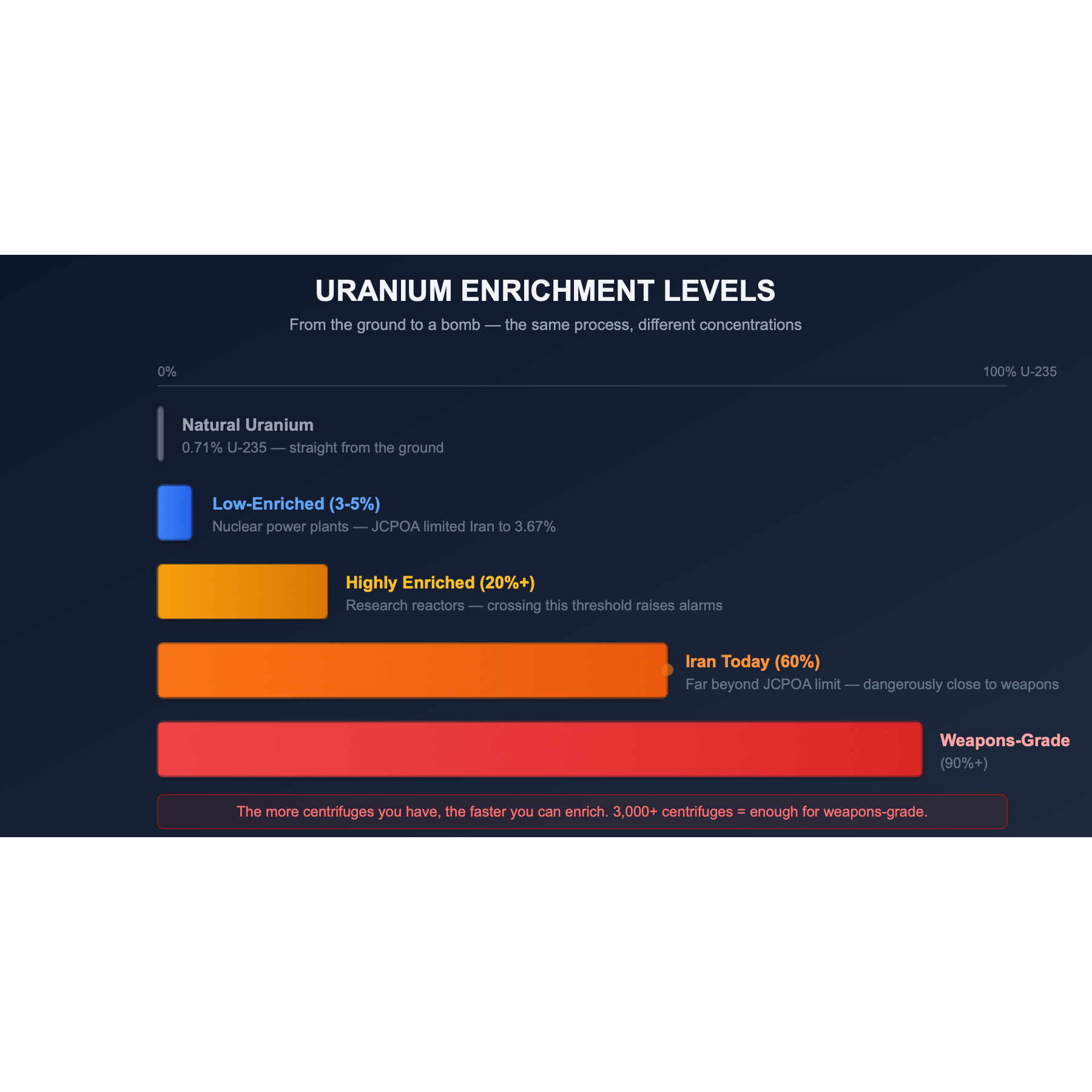
This is why the number of centrifuges Iran has is such a critical issue. More centrifuges = faster path to a bomb.
India, Pakistan, Israel: The Nuclear Domino Effect
To understand Iran’s nuclear ambitions, you need to understand the nuclear domino effect that preceded it.
China tested its first nuclear weapon in 1964. This terrified India, which had fought a war with China in 1962 and lost badly. India’s response was to start its own nuclear weapons program.
In May 1974, India conducted its first nuclear weapons test — code-named “Smiling Buddha” — under Prime Minister Indira Gandhi. India developed the bomb entirely on its own, without stealing plans or buying technology. It was a remarkable achievement.
Pakistan watched India’s test with alarm. If India had the bomb, Pakistan needed one too. But Pakistan didn’t have India’s scientific infrastructure. So they found a shortcut.
Dr. Abdul Qadeer Khan — known as A.Q. Khan — was a Pakistani metallurgist working at a company called Urenco in the Netherlands. Urenco was one of the world’s leading uranium enrichment companies. A.Q. Khan had access to classified centrifuge designs.
He stole them. He photographed classified documents, memorized technical specifications, and quietly relocated to Pakistan in 1975. He then set up Pakistan’s nuclear weapons program in Kahuta, near Islamabad.
Pakistan tested its first nuclear weapon in 1998 — in direct response to India’s second round of tests that year.
But A.Q. Khan didn’t stop there. He turned nuclear technology into a business. He sold centrifuge designs and components to North Korea, Libya, and Iran — creating what became known as the A.Q. Khan nuclear proliferation network, one of the most dangerous black markets in history.

| Country | First Test | Method | Notes |
|---|---|---|---|
| USA | 1945 | Indigenous | Used against Japan (Hiroshima, Nagasaki) |
| USSR/Russia | 1949 | Indigenous + espionage | Cold War rival to USA |
| UK | 1952 | Indigenous | NATO ally |
| France | 1960 | Indigenous | Independent nuclear deterrent |
| China | 1964 | Indigenous | Triggered India’s program |
| India | 1974 | Indigenous | “Smiling Buddha” test |
| Pakistan | 1998 | Stolen technology (A.Q. Khan) | Sold technology to others |
| Israel | Unknown | Unknown | Never confirmed, never denied |
| North Korea | 2006 | A.Q. Khan network | Ongoing threat |
| Iran | Never tested | Pursuing enrichment | Subject of JCPOA |
The A.Q. Khan Network: The Man Who Sold the Bomb
Dr. Abdul Qadeer Khan is simultaneously Pakistan’s greatest national hero and one of the most dangerous proliferators of nuclear technology in history.
In Pakistan, he is celebrated as the “Father of the Islamic Bomb” — the man who gave Pakistan nuclear parity with India. His face appears on postage stamps. Streets are named after him.
To the rest of the world, he is the man who sold nuclear weapons technology to some of the most dangerous regimes on earth.
In 1987, A.Q. Khan made a deal with Iran. For $3 million, he provided Iran with:
- Designs for centrifuges used to enrich uranium
- A list of suppliers who could provide the necessary components
- Technical guidance on building a uranium enrichment facility
This was the moment Iran’s nuclear weapons program truly began.
The United States was aware of A.Q. Khan’s activities. European export control laws at the time were not stringent enough to stop him from buying components on the open market. The CIA had intelligence on his network but — for reasons that remain controversial — did not act decisively to stop him for years.
When A.Q. Khan’s network was finally exposed in 2003-2004, Pakistan’s President Pervez Musharraf pardoned him. A.Q. Khan gave a televised “confession” taking personal responsibility, absolving the Pakistani government of any knowledge. Almost no serious analyst believed this.
Iran’s Secret Program Exposed (2002) and the IAEA Showdown
For years, Iran’s nuclear program operated in the shadows. The world knew Iran had a civilian nuclear program — the Americans had helped build it, after all. But suspicions were growing that Iran was pursuing something more.
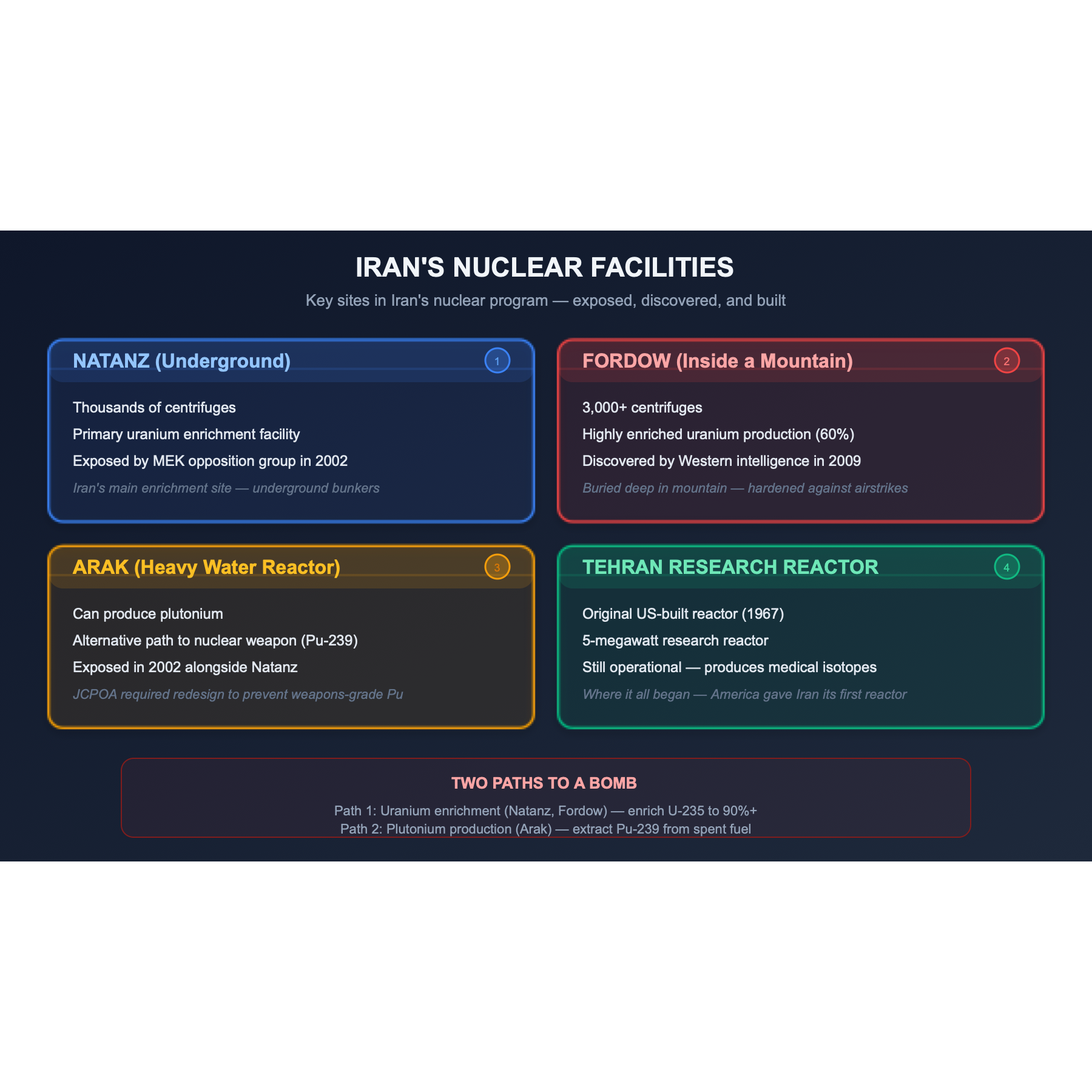
In August 2002, an Iranian opposition group called Mujahideen-e-Khalq (MEK) held a press conference in Washington and dropped a bombshell: Iran had two secret nuclear facilities that had never been declared to international inspectors.
The first was at Natanz — a massive underground uranium enrichment facility with thousands of centrifuges.
The second was at Arak — a heavy water reactor that could produce plutonium (another path to a nuclear weapon).
The MEK was a controversial organization — designated as a terrorist group by the US at the time, with a history of violence. Many suspected the information had been fed to them by Western or Israeli intelligence. But when inspectors went to look, the facilities were real.
The International Atomic Energy Agency (IAEA) — the UN’s nuclear watchdog — demanded Iran explain itself. Iran’s response was defiant. It acknowledged the facilities but insisted they were for peaceful purposes.
In 2003, the IAEA’s Board of Governors passed a resolution demanding Iran suspend all uranium enrichment activities and open its facilities to thorough inspection.
Iran partially complied, then didn’t, then did again. The cat-and-mouse game went on for years.
Then in 2009, Western intelligence agencies discovered another secret facility — this one at Fordow, buried deep inside a mountain near the city of Qom. The capacity of this facility was far beyond what would be needed for civilian nuclear power. It had over 3,000 centrifuges — enough to produce weapons-grade uranium.
The same year, Iran successfully launched its first satellite into orbit. This was alarming for a different reason: the technology used to launch a satellite is essentially the same technology used to launch a ballistic missile carrying a nuclear warhead.
The JCPOA Deal: A Historic Agreement and Its Collapse
By 2013, Iran was under the most severe economic sanctions in its history. The P5+1 (the five permanent UN Security Council members — US, UK, France, Russia, China — plus Germany) had imposed crippling sanctions on Iran’s oil exports, banking system, and financial transactions.
Iran’s currency, the rial, had lost 60% of its value. Inflation was running at 40%. Ordinary Iranians were struggling to buy medicine and basic goods.
A new Iranian president, Hassan Rouhani, came to power in 2013 with a mandate to fix the economy. He was a pragmatist. He understood that the only way to lift the sanctions was to negotiate.
After two years of intense negotiations, the JCPOA was signed in July 2015. The terms:
| Iran Agrees To | World Powers Agree To |
|---|---|
| Reduce uranium stockpile by 98% | Lift nuclear-related sanctions |
| Limit enrichment to 3.67% | Release frozen Iranian assets (~$100B) |
| Reduce centrifuges by two-thirds | Allow Iran to sell oil internationally |
| Allow IAEA inspections | Restore Iran to global financial system |
| Redesign Arak reactor to not produce weapons-grade plutonium | — |
| Limit Fordow facility to research only | — |
It was a genuine compromise. Iran gave up significant nuclear capabilities. The world gave Iran significant economic relief.
But there was a problem. Just three months after signing the JCPOA, in October 2015, Iran tested the EMAD missile — a medium-range ballistic missile capable of carrying a nuclear warhead.
Then it tested more missiles. And more. Iran’s military capabilities expanded dramatically in the years after the JCPOA. The deal had paused the nuclear program but had done nothing to constrain Iran’s missile program or its regional military activities.
This is what gave critics of the deal — particularly in the United States and Israel — ammunition to argue that the JCPOA was fundamentally flawed.
Trump Pulls Out, Iran Pushes Back
On May 8, 2018, President Donald Trump announced that the United States was withdrawing from the JCPOA. He called it “the worst deal ever negotiated” and said the US would reimpose the “highest level” of sanctions on Iran.
Trump’s stated reasons:
- Iran had violated the spirit of the deal by expanding its missile program
- The deal had “sunset clauses” — restrictions that would expire after 10-15 years
- The deal did not address Iran’s regional military activities (support for Hezbollah, Hamas, Houthi rebels)
- Iran had exceeded the enrichment limits set by the JCPOA
The reimposition of US sanctions was devastating for Iran. Oil exports collapsed. Foreign companies that had rushed into Iran after 2015 rushed back out, terrified of US secondary sanctions (which punish non-American companies for doing business with Iran).
India was directly affected. India had been one of Iran’s largest oil customers. Under Trump’s sanctions, India stopped buying Iranian oil entirely. Iran retaliated by removing India from the Farzad-B gas field project — a major gas field that Indian company ONGC had discovered and developed. Iran also removed India from the Zahedan Railway project near the Iran-Afghan border.
Iran’s response to Trump’s withdrawal was measured at first — it stayed in the JCPOA for a year, hoping the other signatories (Europe, Russia, China) would compensate for the loss of US sanctions relief. They couldn’t.
By 2019, Iran began systematically exceeding the JCPOA’s limits:
- Enriching uranium beyond the 3.67% limit
- Increasing its stockpile of enriched uranium beyond the 300 kg limit
- Installing advanced centrifuges banned by the deal
- Reducing IAEA inspector access

The Assassination of Qasem Soleimani and What Followed
On January 3, 2020, a US drone strike at Baghdad International Airport killed Major General Qasem Soleimani — the commander of Iran’s Quds Force, the elite unit of the IRGC responsible for Iran’s military operations across the Middle East.
Soleimani was arguably the second most powerful man in Iran, after Supreme Leader Ali Khamenei. He had orchestrated Iran’s military strategy in Iraq, Syria, Lebanon, and Yemen for two decades. He was simultaneously a war hero to Iranians and a designated terrorist to the United States.
His assassination was the most dramatic escalation in US-Iran relations in decades.
Iran’s response was swift and symbolic: it launched ballistic missile strikes on two US military bases in Iraq. No Americans were killed (Iran apparently gave advance warning through Iraqi channels), but the message was clear: Iran could hit American targets.
More significantly, Iran announced it would no longer comply with any of the limits set by the JCPOA. The deal was effectively dead.
The reaction in Europe was telling. France, Germany, and the UK — who had spent years defending the JCPOA — began frantically negotiating with Iran, begging it to stay within the limits. Iran’s response: go tell Washington to lift the sanctions.
This was Iran’s diplomatic masterstroke. By threatening to fully abandon the JCPOA, Iran had made itself the indispensable party. No one was going to attack Iran — the consequences would be catastrophic. No one was going to ignore Iran — the nuclear threat was too real. Iran had learned to use its nuclear program as the ultimate bargaining chip.
Where Things Stand Today
When Joe Biden came to power in January 2021, he promised to rejoin the JCPOA. Negotiations began in Vienna. But they have been slow, complicated, and repeatedly stalled.
Iran’s new president Ibrahim Raisi — elected in 2021 — came to power with a mandate to fix the economy. He needs sanctions relief. But he also needs to show domestic hardliners that Iran is not capitulating to American pressure.
Meanwhile, Iran’s nuclear program has advanced significantly beyond where it was in 2015:
- Iran is now enriching uranium to 60% — far beyond the 3.67% JCPOA limit, and dangerously close to weapons-grade (90%)
- Iran has installed thousands of advanced centrifuges
- Iran’s uranium stockpile is now 18 times the JCPOA limit
- IAEA inspectors have been denied access to key facilities
The IAEA has warned that Iran is now just weeks away from having enough weapons-grade uranium for a nuclear bomb — if it chose to enrich to that level.
Israel has repeatedly threatened military strikes on Iran’s nuclear facilities. The United States has said “all options are on the table.” Iran has said any attack would be met with devastating retaliation.
The world is in a more dangerous place than it was in 2015.
Key Takeaways
-
America started Iran’s nuclear program — the 1967 reactor at Tehran University was built by the United States.
-
A.Q. Khan’s network gave Iran the weapons technology — Pakistan’s nuclear scientist sold centrifuge designs to Iran in 1987.
-
The JCPOA was a genuine compromise — Iran gave up significant capabilities, the world gave significant relief.
-
Trump’s withdrawal broke the deal — and Iran has been advancing its program ever since.
-
Iran uses its nuclear program as a bargaining chip — not necessarily to build a bomb, but to force the world to negotiate.
-
The assassination of Soleimani was a turning point — it ended any remaining Iranian goodwill toward the JCPOA.
-
The world is more dangerous without the JCPOA — Iran is now closer to nuclear weapons capability than at any point in its history.
Why This Matters Today
Iran’s nuclear program is not just about Iran. It is about the entire architecture of nuclear non-proliferation.
If Iran gets a nuclear weapon, Saudi Arabia has already said it will pursue one too. If Saudi Arabia gets one, Turkey will want one. The Middle East — already the world’s most volatile region — could become a multi-nuclear-armed zone within a decade.
Israel, which is believed to have 80-400 nuclear warheads, has made clear it will not allow Iran to develop a nuclear weapon. An Israeli military strike on Iran’s nuclear facilities would almost certainly trigger a regional war involving Hezbollah in Lebanon, Hamas in Gaza, Houthi rebels in Yemen, and Iranian-backed militias in Iraq and Syria.
The JCPOA, for all its flaws, was the only mechanism preventing this scenario. Its collapse has brought the world significantly closer to a catastrophic conflict.
The question is no longer whether Iran can build a nuclear weapon. The question is whether the world can find a diplomatic solution before someone decides to use military force — and whether that military force would solve anything, or simply delay the inevitable while igniting a war.
Glossary
| Term | Simple Explanation |
|---|---|
| JCPOA | Joint Comprehensive Plan of Action — the 2015 nuclear deal between Iran and the P5+1 world powers |
| P5+1 | The five permanent UN Security Council members (US, UK, France, Russia, China) plus Germany — the countries that negotiated the JCPOA with Iran |
| IAEA | International Atomic Energy Agency — the UN’s nuclear watchdog, responsible for inspecting nuclear facilities |
| Uranium enrichment | The process of increasing the concentration of U-235 in uranium, used for both nuclear power and nuclear weapons |
| Centrifuge | A machine that spins uranium gas at high speed to separate U-235 from U-238 |
| U-235 | The isotope of uranium used as fuel for nuclear reactors and nuclear weapons (only 0.71% of natural uranium) |
| U-238 | The more common isotope of uranium (99.28% of natural uranium), not suitable for weapons |
| Sanctions | Economic penalties imposed by one country on another — restricting trade, freezing assets, blocking financial transactions |
| Ballistic missile | A missile that follows a curved trajectory and can carry nuclear warheads over long distances |
| Natanz | Iran’s main underground uranium enrichment facility, exposed in 2002 |
| Fordow | Iran’s secret enrichment facility buried inside a mountain, discovered in 2009 |
| Atoms for Peace | Eisenhower’s 1953 program to share civilian nuclear technology with the world |
| NPT | Nuclear Non-Proliferation Treaty — international agreement to prevent the spread of nuclear weapons |
| A.Q. Khan | Pakistani nuclear scientist who stole centrifuge designs from Europe and sold them to Iran, North Korea, and Libya |
| EMAD missile | Iran’s medium-range ballistic missile, tested in October 2015 just months after signing the JCPOA |
| Quds Force | The elite unit of Iran’s IRGC responsible for military operations outside Iran |
| IRGC | Islamic Revolutionary Guard Corps — Iran’s ideological military force, separate from the regular army |
| Qasem Soleimani | Commander of Iran’s Quds Force, assassinated by US drone strike in January 2020 |
This article is based on publicly available geopolitical analysis. All views expressed are analytical in nature.

