> “For 40 years Pakistan has been playing the role of a middleman. After 40 years, Pakistan has been successfully isolated — both by its child, the Taliban, and by its masters.”
Introduction
When the Taliban took Kabul in August 2021, most of the world’s attention was on the chaos at the airport — desperate Afghans clinging to the wheels of departing planes, American soldiers scrambling to evacuate civilians. It was raw, visceral, heartbreaking television.
But in the quiet rooms of foreign ministries in New Delhi, Beijing, and Tehran, something else was happening. Diplomats were making calls. Back-channel negotiations were opening. Strategic calculations were being revised.
Because Afghanistan’s collapse was not just a humanitarian crisis. It was a geopolitical earthquake — and the aftershocks were going to reshape the entire region. The question was: who would benefit, who would lose, and who would be left holding the rubble?
This is the story of the real game being played around Afghanistan — a game far more consequential than anything that happened on the battlefield.
Why Afghanistan Is the Most Strategically Important Landlocked Country on Earth
Afghanistan has no coastline. It has no major rivers that reach the sea. It has almost no functioning industry. And yet every major power in the world has fought over it for centuries.
The reason is geography.
Afghanistan sits at the exact center of the Eurasian landmass — the junction between South Asia, Central Asia, and the Middle East. It is the only land bridge connecting these three regions. Any country that wants to move goods, troops, pipelines, or influence between these regions must either go through Afghanistan or take a vastly longer route.
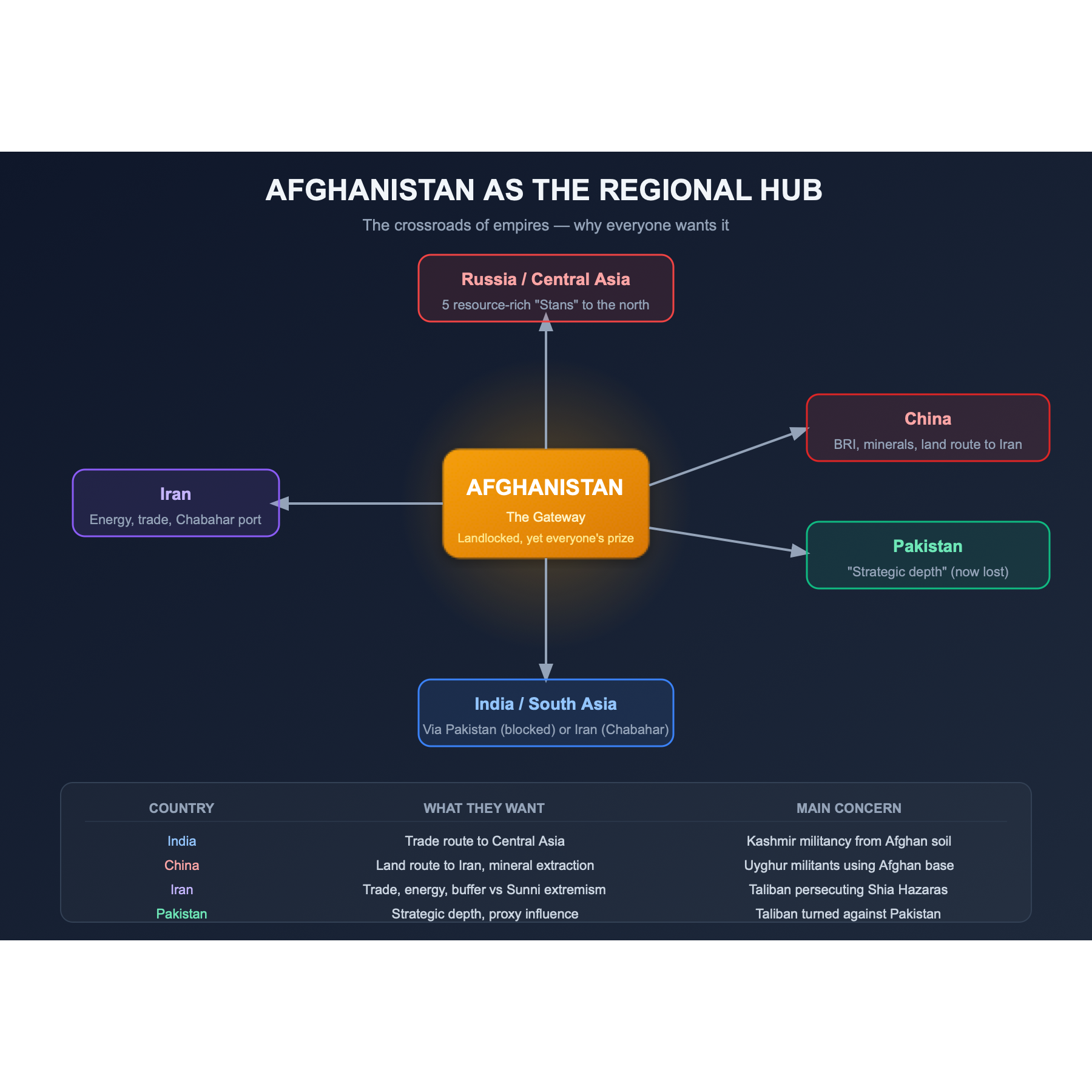
For India, Afghanistan is the gateway to Central Asia — five resource-rich countries (Kazakhstan, Kyrgyzstan, Tajikistan, Turkmenistan, Uzbekistan) that India wants to trade with. The problem: Pakistan sits between India and Afghanistan, and India and Pakistan are enemies. So India uses Iran’s Chabahar port as an alternative route — bypassing Pakistan entirely.
For China, Afghanistan is the missing link in its Belt and Road Initiative (BRI) — the trillion-dollar infrastructure project to connect China to Europe, the Middle East, and Africa by land. China has already invested $50+ billion in Pakistan through CPEC (China-Pakistan Economic Corridor). Connecting that to Kabul would give China a land route all the way to Iran, the Persian Gulf, and beyond.
For Iran, Afghanistan is a neighbor it cannot ignore. A stable, friendly Afghanistan means trade, energy pipelines, and a buffer against Sunni extremism. An unstable Afghanistan means millions of refugees and a base for anti-Shia terrorism.
For Pakistan, Afghanistan has always been its “strategic depth” — a buffer against India, a source of leverage with the United States, and a market for its proxy forces. But that calculation has now collapsed.
| Country | What They Want from Afghanistan | Main Concern |
|---|---|---|
| India | Trade route to Central Asia, no Pakistan proxy influence | Taliban using Afghan soil for Kashmir militancy |
| China | Land route to Iran/Middle East, mineral extraction | Uyghur militants using Afghan base |
| Iran | Trade, energy, buffer against Sunni extremism | Sunni Taliban persecuting Shia Hazaras |
| Pakistan | Strategic depth, proxy influence, relevance | Taliban turning against Pakistan |
| Russia | Stable buffer, no NATO expansion | Islamist militancy spreading north |
| USA | No Chinese/Russian dominance, counter-terrorism | China filling the vacuum |
India’s Quiet Play: Building Equity While Pakistan Burned Bridges
India’s relationship with Afghanistan is one of the most underappreciated stories in South Asian geopolitics.
Since the 1990s, India has been quietly building influence in Afghanistan — not through military force, but through something far more durable: goodwill.
Under Prime Minister Narasimha Rao in the early 1990s, India was the first government to reach out to the Mujahideen government in Kabul and build relationships with Afghan warlords. India provided medical supplies, humanitarian aid, and technical assistance. No strings attached. No loans to be repaid.
Over the following decades, India built:
- The Salma Dam (also called the Afghan-India Friendship Dam) in Herat province
- The Afghan Parliament building in Kabul
- Hundreds of schools and hospitals across the country
- The Zaranj-Delaram Highway connecting Afghanistan to Iran’s Chabahar port
- Consulates in Kandahar, Herat, Jalalabad, and Mazar-e-Sharif
Total Indian investment: approximately $3 billion. For India, this was essentially aid — given without expectation of financial return.
Compare this to China’s CPEC — $50+ billion in loans that Pakistan must repay, with Chinese workers building Chinese infrastructure on Pakistani soil.
When the Taliban took over in 2021, Pakistani social media celebrated: “India’s investment in Afghanistan has gone to waste!”
The Taliban’s response was instructive. They said: “We will not destroy any Indian investment in Afghanistan. We will make use of it.”
This was not an accident. The Taliban understood that India’s investment was humanitarian — roads, dams, schools. These serve the Afghan people. Destroying them would turn the Afghan public against the Taliban.

India also has a critical strategic asset: an air base in Tajikistan (Farkhor Air Base), giving it direct access to Afghanistan’s northern border without going through Pakistan.
The Taliban has also made a significant statement regarding Kashmir: “We have no interest in Kashmir if India does not interfere in Afghanistan’s internal matters.”
This is a dramatic shift from the 1990s, when Taliban-controlled Afghanistan was a staging ground for Pakistani-sponsored militants entering Kashmir. The new Taliban is signaling that it wants to be a government, not a proxy.
China’s Grand Design: Belt, Road, and the Race to Kabul
China’s interest in Afghanistan is not sentimental. It is coldly strategic.
China shares a small but significant border with Afghanistan — the Wakhan Corridor, a narrow strip of land in Afghanistan’s Badakhshan province, roughly 50 km wide. This is China’s direct land access to Afghanistan.
But China’s real interest is what lies beyond Afghanistan: Iran, the Persian Gulf, the Arabian Sea, and the Indian Ocean.
China is the world’s largest importer of oil. Its primary supply route is the South China Sea — a route that is constantly monitored by the US Navy, the Indian Navy, and the Quad (US, Japan, India, Australia). China desperately wants an alternative land route that bypasses this chokepoint.
The plan:
- CPEC connects China’s Xinjiang province to Pakistan’s Gwadar port on the Arabian Sea (already partially built, $50+ billion invested)
- Extend CPEC from Peshawar to Kabul — making Kabul part of the Belt and Road Initiative
- From Kabul, connect to Iran — which China has already signed a $400 billion MOU with
- From Iran, access the Persian Gulf, Caspian Sea, and Middle East

China has already met directly with Taliban leadership — in Beijing, without Pakistan being invited. The Taliban spokesman called China’s invitation “a gift of legitimacy.” In return, Taliban assured China it would distance itself from the East Turkestan Islamic Movement (ETIM) — a Uyghur militant group that China considers a direct threat to its national security.
China also wants Afghanistan’s vast mineral wealth: coal, copper, iron ore, lithium, uranium, gold, and precious stones. Afghanistan may have the world’s largest lithium deposits — critical for electric vehicle batteries. China wants all of it.
But there is one condition: Afghanistan must be stable. You cannot mine minerals or build roads in a war zone. This is why China needs the Taliban to govern effectively — and why China is willing to recognize the Taliban government when no Western country will.
Iran’s Calculated Gamble: Sunni Enemies, Economic Necessity
Iran’s relationship with the Taliban is one of the most counterintuitive in modern geopolitics.
In 1998, Taliban fighters murdered 11 Iranian diplomats and a journalist in Mazar-e-Sharif. Iran nearly went to war with Afghanistan over it. The Taliban are Sunni extremists who consider Shia Muslims (Iran’s majority) to be heretics. They have persecuted Afghanistan’s Hazara community — Shia Afghans — for decades.
And yet, in 2021, Iran was talking directly to the Taliban. Iran was even supplying fuel to the Taliban regime.
How do you explain this? One word: pragmatism.
Iran has been under crushing US sanctions for decades. Its economy is struggling. Its currency has collapsed. Its people are suffering. Iran desperately needs trade partners, and Afghanistan — despite everything — is a neighbor with shared borders, shared history, and shared economic interests.
Iran also had a strategic reason to want the US out of Afghanistan. An American military presence on Iran’s eastern border was a constant security threat. The Taliban, for all their faults, are not going to launch a war against Iran. The Americans might.
Iran also has a new president — Ibrahim Raisi — who came to power in 2021 with a mandate to fix the economy. He needs trade. He needs investment. He needs the US sanctions lifted. And he needs China — which is why Iran signed the $400 billion MOU with China, and why Iran is now part of the same strategic axis as China and the Taliban.

Pakistan’s Isolation: How the Middleman Lost the Middle
For 40 years, Pakistan’s entire foreign policy was built on one idea: we are strategically indispensable. We are the gateway to Central Asia. We are the only country that can manage the Taliban. We are the bridge between the Islamic world and the West. Pay us, arm us, support us — or lose access to this entire region.
It worked. For 40 years, it worked brilliantly.
Then it stopped working all at once.
The United States left Afghanistan without calling Pakistan. Joe Biden did not call Imran Khan even once after announcing the withdrawal — a stunning diplomatic snub that signaled exactly how much America valued Pakistan’s “strategic importance” in 2021.
China started talking directly to the Taliban — without Pakistan as the middleman.
Iran started talking directly to the Taliban — without Pakistan as the middleman.
The Taliban itself started ignoring Pakistan — telling it to remove the visa/passport system, refusing to crack down on TTP, and treating Pakistani diplomats with barely concealed contempt.
Pakistan is now isolated in a way it has never been before:

Pakistan’s Finance Minister Shaukat Tareen admitted in Pakistan’s National Assembly: “Pakistan has become a net importer of food. We don’t have wheat. We don’t have sugar. We are importing 70% of our pulses.”
A country that cannot feed itself cannot project power. Pakistan’s strategic leverage has evaporated.
CPEC, POK and the Kashmir Connection
There is one more dimension to this story that connects everything: CPEC passes through POK.
POK (Pakistan-Occupied Kashmir) is the territory that Pakistan has controlled since the 1947 partition — but which India considers its own sovereign territory. It is a disputed region, and the dispute has never been resolved.
China’s CPEC — the $50+ billion infrastructure corridor — runs directly through POK, through the Gilgit-Baltistan region, down to Gwadar port in Balochistan.
India has protested this loudly. You cannot build infrastructure in disputed territory and expect the other claimant to stay silent. China’s response has essentially been: we know it’s disputed, and we don’t care.
This creates a fascinating strategic triangle:
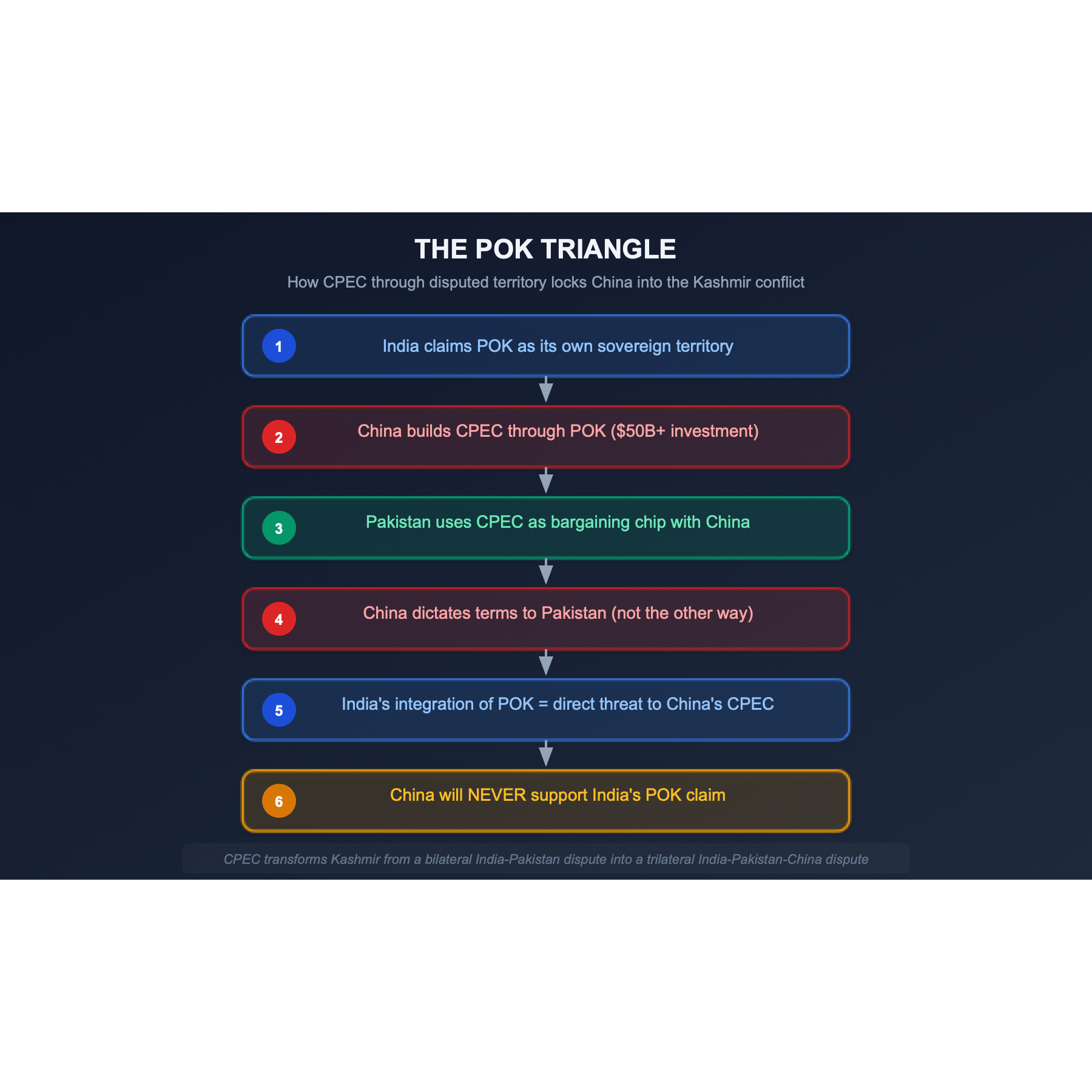
India’s long-term hypothesis: as Pakistan implodes economically, as TTP destabilizes Khyber Pakhtunkhwa, as Baloch nationalism grows in Balochistan — POK will become increasingly isolated from the Pakistani state. At that point, India can move to integrate it.
When that happens, India will have a direct land border with Afghanistan — and the entire strategic calculus of the region changes.
What India Should Do Next
India’s position in this new landscape is actually stronger than it appears. Here is the strategic logic:
-
Wait for Pakistan to implode — the economic collapse, TTP insurgency, and Pashtun nationalism are doing India’s work for it. India does not need to fire a single bullet.
-
Maintain the Chabahar port connection — India’s route to Afghanistan through Iran must be kept open and expanded. This is India’s lifeline to Central Asia that bypasses Pakistan entirely.
-
Keep talking to both the Taliban and the Northern Alliance — India should not put all its eggs in one basket. The Taliban may govern Kabul, but the Northern Alliance controls Panjshir and has the support of Tajiks, Hazaras, and Uzbeks — 60% of the Afghan population.
-
Use the mineral wealth angle — Afghanistan’s lithium deposits are enormous. India needs lithium for its electric vehicle industry. A deal with the Taliban on mineral extraction could be mutually beneficial.
-
Let China overextend — China is pouring money into Pakistan and Afghanistan. Both are unstable, corrupt, and ungovernable. China will eventually face the same lesson that Britain, the Soviet Union, and America learned: Afghanistan is the graveyard of empires.
Key Takeaways
-
Afghanistan is a strategic hub — every major power wants it because it connects South Asia, Central Asia, and the Middle East.
-
India played the long game — humanitarian aid, no strings attached, and it paid off. The Taliban respects India’s investment.
-
China wants the land route — CPEC + Kabul + Iran = China’s alternative to the US-monitored sea route.
-
Iran chose pragmatism over ideology — economic necessity trumped religious differences.
-
Pakistan is isolated — its 40-year strategy of being the indispensable middleman has collapsed.
-
CPEC through POK is China’s stake in the Kashmir dispute — China will never be neutral on Kashmir as long as CPEC exists.
-
The real winner of the US withdrawal is China — but China still needs a stable Afghanistan, which it doesn’t have.
Why This Matters Today
The withdrawal of the United States from Afghanistan did not end the Great Game — it started a new one. The players are different (China instead of Britain, India instead of a colonial subject), but the prize is the same: control of the crossroads of the world.
India is in a stronger position than it has been in decades. Pakistan is weaker than it has ever been. China is overextended and facing the same governance problems that defeated every previous empire in Afghanistan.
The next decade will determine whether India can convert Pakistan’s collapse into a strategic opportunity — integrating POK, securing the Chabahar route, and building durable relationships with whoever governs Afghanistan.
The chessboard has been reset. The pieces are moving.
Glossary
| Term | Simple Explanation |
|---|---|
| CPEC | China-Pakistan Economic Corridor — $50+ billion Chinese infrastructure investment connecting China to Pakistan’s Gwadar port |
| BRI | Belt and Road Initiative — China’s global infrastructure project to connect China to Europe, Africa, and the Middle East by land and sea |
| POK | Pakistan-Occupied Kashmir — territory controlled by Pakistan since 1947, claimed by India as its own sovereign territory |
| JCPOA | Joint Comprehensive Plan of Action — the 2015 nuclear deal between Iran and world powers (US, UK, France, Germany, Russia, China) |
| Chabahar Port | An Iranian port on the Arabian Sea that India uses to access Afghanistan and Central Asia, bypassing Pakistan |
| Northern Alliance | Coalition of non-Pashtun Afghan ethnic groups (Tajik, Hazara, Uzbek) opposing the Taliban |
| Quad | Security dialogue between USA, Japan, India, and Australia — monitors China’s activities in the Indo-Pacific |
| Farzad-B | A major gas field in Iran discovered by Indian company ONGC — Iran removed India from the project under Trump-era sanctions pressure |
| Durand Line | The 1893 colonial border between Afghanistan and Pakistan, never recognized by Afghanistan |
| Ummah | The global community of Muslims — Taliban uses this concept to argue against visa/passport systems between Muslim countries |
| FATF | Financial Action Task Force — international body that monitors money laundering and terror financing; Pakistan has been on its grey list |
| Wakhan Corridor | The narrow strip of Afghan territory (~50km wide) that shares a border with China |
| Gilgit-Baltistan | The northern region of POK through which CPEC passes |
| TTP | Tehrik-e-Taliban Pakistan — the Pakistani Taliban, fighting to establish Sharia in Pakistan |
| PTM | Pashtun Tahafuz Movement — a civil society movement of Pashtuns in Pakistan demanding rights and opposing military operations |
This article is based on publicly available geopolitical analysis. All views expressed are analytical in nature.

